Table of Contents
The Beet Industry
The homesteaders in the first decades of the 1900’s recognized that the production from the fertile soils of the area could be greatly increased if only there could be more water. In the dry climate of southern Alberta, growing sugar beets and other specialty crops such as potatoes, alfalfa, and corn would be impossible without irrigation. In response to a petition sent to Ottawa asking that an an investigation be undertaken to determine the feasibility of irrigation, the I Lethbridge Northern Irrigation District was formed. The district comprised an irregular tract of bench land on the north side of the Old Man River water was stretching from Fort Macleod on the west to Turin on the east. Survey for the canals was begun in 1921 and the waste was turned into the main canal in 1923. The water was delivered through canals to the farms. Canvas dams placed at intervals along the farm ditches held the water back so that it flooded out onto the fields and was directed into furrows between the rows of beets.
Flood irrigation depended on gravity flow of the water, which meant that the farmer had to survey the land to determine the location of the ditches in order to have a downhill run. Then each field was leveled mechanically with a tractor or horse drawn leveler called a float. At that time sugar beets were seeded with a four-row beet drill with rows twenty-two apart.
Some types of soil develop a crust on the surface that would prevent the tender sugar beets from coming through. This problem was overcome by using a machine called a crust-buster which had a series of small spiked or tapered wheels that broke up the crust without seriously damaging the beets. (An example of inventive mechanical genius to solve a problem.)
In 1925 the first sugar beets grown in this area were shipped by rail to the Raymond factory to be processed.The number of acres seeded to sugar beets in southern Alberta increased from 7,232 in 1925 to 14,109 in 1935. This expansion of sugar beet acreage resulted in the need for another factory as Raymond could not handle the increased volume The construction of the Canadian Sugar Factory in Picture Butte started in 1935.
To provide for the large amount of water required for sugar beet processing the Lethbridge Northern Irrigation District constructed a large dam that could be filled with water from the irrigation canal. The structure was reinforced by driving pilings dam t into the ground and then covering them with tons of earth. A protective layer of stones completed the barrier. The historic butte, for which Picture Butte was named, was removed one truckload at a time and provided the base for the new road.
The $1.5 million factory was completed the next year, and the first run began on October 4, 1936. It had the capacity to process 1,000 tons of beets per day. The early crop rotations were on a three-year cycle- grain, sweet clover, and sugar beets. The sugar beets take a great many of the nutrients from the soil and these are returned by burying the grain stubble and by plowing down the nitrogen rich sweet clover
Following is a brief description of the process of refining sugar from the sugar beet. (Quoted from the Lethbridge Herald dated Saturday October 3, 1936):
“From the unloading sheds the beets are washed through me with high pressure hot water hose into the beet wheel which carries the beet into the washer The washer removes the last foreign matter from the beets. Then several sets of been blades cut the beets into long Vaped pieces or shoe-strings. The slices are treated for nearly an hour in the diffusion battery where warm water used to soak out the sugar in the carbonators milk of lime and carbon dioxide are added to the juices for purification. Then the juice is filtered and sulphur dioxide is added which neutralizes the alkaline and results in much lighter colored syrup. Evaporators boil the liquid down to much thicker syrup. The syrup is then further boiled furiously in a vacuum pan until crystal form. Finally the centrifugal whirlers produce the clear white crystals of sugar, which is then dried and sacked. From the residue of the beets come wet beet pulp, a splendid dairy and stock feed. The other by-product is molasses, which when mixed with the beet pulp provided a very nutritious and palatable livestock feed”.
As many as ten or twelve plants grew from each seed which resulted in the need for thinning. If the plants are too close together, the roots are crowded and do not develop properly. All but the strongest plants about eight inches apart were cut out with the hoe or pulled out with the fingers. This was slow physical labor. Weeding with a hoe was likewise intensely laborious. Mechanical weeding with a cultivator was done with a cultivator equipped with “duck-foot shovels” which dug a trench between the rows of beets. The water flowed into these trenches using small metal pipes embedded in the ditch banks at twenty-two inch intervals. This, too, was very time consuming and slow work. Later siphon hoses replaced the metal pipes, thus reducing the time. In a normal growing season, the sugar beets were irrigated two or three times.
The earlier attempts at constructing mechanical beet diggers were by adapting the existing potato harvesters. After the beets were lifted out of the ground, the tops were cut off by hand using a specially designed knife.
The beet tops or leaves were tossed into piles or rows to be later picked up for cattle feed. The tops provided an inexpensive but highly nutritious feed for fattening livestock. Thus the sugar industry and the beef industry developed a symbiotic relationship: the beet tops and pulp providing feed for the cattle and the cattle manure spread on the land helped restore fertility.
The beetroots were tossed into piles or rows to be later loaded into a wagon by means of a beet fork.
The early sugar beet wagons were drawn by horses and the box so designed that the sides could be let down for easy unloading at the factory. By this process one acre of sugar beets required sixty man hours of labor.
The sugar beets were delivered from the farm to one of several beet dumps located throughout the district. Some of those locations were: Becker, Whitney, Iron Springs, Tenion (Turin), Diamond City, and Monarch.
As the beets were unloaded they passed over a series of “kicker wheels” (several rows of rubber coated steel wheels with each row turning in opposite direction). The purpose of this machine was to remove any small stones, dirt, or other debris from the beetroots. (Another example of mechanical inventiveness) This excess material or tare was then transferred back to the farmer’s wagon or truck to be taken back and spread on the fields. Some of the dumps e.g. lron Springs were located alongside a railway siding and the beets could be loaded directly onto railway cars for shipment to the factory. Other dumps e.g. Turin had mobile pilers which produced huge piles of beets 1/4 mile long, 60 feet wide and up to 16 feet high. These piles of beets were later hauled by truck to railway lines or directly to the factory. Some beet pilers were located on the grounds of the sugar factories
The history of labor supply involved a number of different groups of people. First there were the Czechs, Hungarians and Austrians. In 1929, 3 or 4 train cars arrived in Lethbridge, each containing 25 families who went to work the beet growers. Many of these people eventually became landowners and beet growers themselves. Later the labor need was met by hiring Dutch people, Polish war veterans, Japanese evacuees from BC, German prisoners of war, and immigrants of all nationalities from displaced persons camps in Germany. During the 1950’s and 1960’s Indians from various reserves were brought in. The shortage of satisfactory laborers resulted in some farmers temporarily switching to other crops.
Farmers were often hard pressed to provide adequate housing for their beet workers. The Lethbridge Northern Irrigation District advanced funds, on a basis, for the building of a
standardized “beet shack”. A few of these original shacks may still be in existence.
Often two different harvesting machines were used. For example, one unit might top several rows of beets, while another lifted the beets out of the ground and placed them in windrows, while a third machine would elevate the beets into a truck or trailer. By 1952 mechanization had basically replaced the hand harvesting methods Because of the decline of available and satisfactory laborers to perform the largely hand operations farmers began to use mechanical thinners, multiple and four row lifters and loaders. The now topper first boot loader in the district was made by Andrew Briosi and Lloyd Anderson.
An outstanding feature of the mechanical harvesters was the complete recovery, in undisturbed windrows, of beet tops for cattle feed. The new machines lifted the beets out of the ground and conveyed them directly to trucks. Thus the topping and loading by hand labor became obsolete and the beet knife and fork have become museum items. Also the development of monogerm seeds (from which only one plant would grow from each seed) and the use of precision drills, and greater seedbed preparation, all contributed greatly to solving the spring labor problems.
Although the Picture Butte Factory developed into a very efficient operation, the larger factory in Taber (1949) had the capacity to process all the sugar beets grown in Southern Alberta. So, the decision was made in 1977 to cease operation of the Picture Butte factory. Another compelling reason for this decision was that Alberta Environment required that the wastewater treatment be upgraded. This expense was avoided by consolidating all the processing in the Taber plant. For a number of years the Picture Butte used for storage of bulk sugar, and more recently that too, has been discontinued.
In the early 1980’s, the very existence of the Alberta sugar industry was threatened with competition from lower priced imported cane sugar In 1985, despite valiant efforts by the Sugar Beet Growers, the B.C. Sugar Company refused to sign an acceptable contract and for the first time in 60 years, no sugar beets were seeded in south Alberta that year. The factory at Taber continued to package and distribute sugar from the 1984 cop as well as cane sugar shipped in from Vancouver. In March 1986, the Federal Government announced the long awaited domestic sugar policy. It provided $10 per subsidy, an equal provincial subsidy plus the promise of a national sugar policy within year. This was sufficient incentive for the growers, and contacts were signed with the Alberta Sugar Company for seeding a total of 30,000 acres of sugar beets in 1986. Efforts continued under the persistent and effective leadership of Water F. Boras to persuade the Federal Government to enact a National Sugar Beet Stabilization Program. This was finalized in April 1987, when a ten-year stabilization program was signed which called for equal contributions from the farmers, the provincial government, and the federal government to build a fund to make up for deficiencies during years of suppressed prices
Following is a statistical summary provided by Doug Emek:
*Since the Picture Butte factory was closed in 1977, gar beet acreage in southern Alberta has varied from high of 44.522 acres in 1999 to a low of 18.161 acres in 2008.
*The average acreage between 2000 and 2012 was 30,800 acres.
*The number of beet contracts signed each your has declined from about 800 in the 1970’s to 207 in 2012.
*The average contract size has tripled from less than 50 acres during the 1970’s to almost 150 acres in 2012.
Average yields continue to increased due to improvement in varieties and practices. Average yields over the last 4 decades have been as follows:
1970’s-14.4 tonnes/acre
1980’s-18.2 tonnes/acre
1990’s-19.3 tonnes/acre
2000’s 21.9 tonnes/acre
2012-27 tonnes/acre
*Beet quality has increased dramatically with a corresponding increase in the amount of sugar produced from each acre. Sugar per acre over the last 4 decades has been the following:
1970’s-1768 kg/acre
1980’s-2130 kg/acre
1990’s-2372 kg/acre
2000’s-1058 kg/acre
*Although the Raymond and the Picture Beer factories closed many years ago, total sugar production from the Taber factory is now more than the combined output of all three plants.
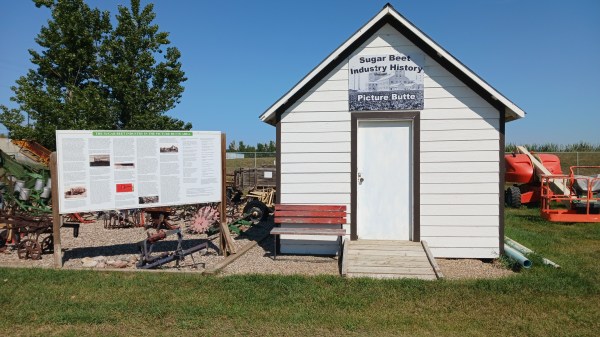
*Following is a list of some of the antique equipment on display in this area
- John Deere 4-horse-drawn sugar beet drill
- Minneapolis 4-row horse-drawn beet cultivator
- McCormick Deering row horse drawn beet cultivator
- Cockshutt 4-row horse-drawn beet cultivator
- IHC 1-row horse-drawn beet lifter
- IHC 1-row tractor mount lifter
- John Deere 1-row horse-drawn beet lifter
- John Deere 2-row tractor mount beet lifter
- Briosi self propelled beet thinner
- John Deere beet loader
- Robin (Robeco) beet loader
- Handley 2-row tractor drawn beet windrower
- Lockwood tractor mounted beet topping machine
- Kirschner beet topper whipper rake
The information on this sign and the display of antique sugar beet machinery tell the story of backbreaking hand labor being replaced by mechanized equipment. Visitors to this should appreciate the preservation of this part of our agricultural heritage.
If you are interested in a more detailed account of the sugar beet industry
in southern Alberta, be sure to read the recent book:
“Southern Alberta’s Sugar Coated History: Sugar Beets and Southern Alberta” wiritten by Belinda Crewson, 2013. Published by the Lethbridge Historical Society. A copy is available in this museum’s library.
Also, Bryan Rudelich has prepared a visual display on the sugar beet industry. It is hanging in the freight shed of the station. Be sure to see it.
John Rudelich Interview
Today is January 26th of 2025 and I am here at John Rudelich’s house. And for him to provide us a little story of his himself, his family in regards to the sugar, beet industry. So I’m going to let it to you. John, you go right ahead and feel free to say what you feel.
You’re comfortable with. Well, my connection to the sugar beet industry. Started. We’ll go back as far as my dad. My dad came to the area. From Edmonton in 1936 because, well, everybody knows about the depression and work was hard to find and there was It was work in the sugar beet fields here, that’s what he originally came for.
So he worked in various places in the in the Sugar Beat fields hoeing, topping, and loading and all that stuff and then. You got a job? And the Sugar Factory for campaign. I think for a couple of years and then, Then he got on their permanent and worked for them for approximately 25 years, I believe.
In various positions and he ended up as pulp dryer operator. And, And then so my history with it. So I ended up working my mother and I both work. In the beat fields with them and then When I turned 16, I got a part-time job there in campaign as a sample Chaser.
Uh, and I was going to school and, and only working the night shift. So it was difficult, but it provided some money. And I don’t remember, I think I was getting 67 cents. An hour or something like that. And then, and then I worked. I don’t remember exact years but it worked a few Summers.
For them like loading sugar into cars bags into cars and Various. Labor. Situations there with them. And then in 1964. Or 1963. I’m sorry, they offered me. A permanent job. And so, then, I worked. I worked for them. In. Various positions. I ended up of a sugar beet foreman.
And I and I apprentice for a welder and carpenter there as well. And, Then. In 1978 when they closed the picture-beard planned by opted on. Leaving the company. And uh, but I must say this that that the company provided a living for very, very many people here and we we wouldn’t be the place we are, if it wasn’t for that company and there were a very good company to work for.
I mean, I chose to leave. Uh, because I wasn’t they were playing different music than when I started. At least, it wasn’t suiting me. I felt like a square peg in her own hole and it was my opportunity to leave and on. And, But, The company itself was a wonderful company to work for and and you could learn a lot of things there.
If you wanted to, there are good people uh, as a family-run business and then it became later. A larger corporation, but like, They were very, very good to my dad. And, and good to our family and and good to everybody. They’re They were just a number one place to work for they had.
Good of all of these The pay was. You know, I think when I’ve left there, I was getting seven 78 an hour which 78 was a pretty good wedge and I had six weeks of holidays and And I was just well treated all the way around and they were they were compassionate and They helped me when I built my first house.
They sold me their property. Very reasonable. I used their equipment. Either very reasonably or at no charge and so So, I have a lot to be thankful for working for them and And uh you know the history is is quite good and like if you’d like to see more history, There’s a museum.
Located. Flats Museum, which is Other people know it as a prairie tractor Museum. And and it’s it’s presently being worked on. It’s uh it’s it’s in you can go into it but it’s riding to it instead he And, And trying to make it. Representative of the industry. And I guess that’s all I have to say, but I had a very good Around 20 years part-time, and and full-time.
Working for them. And Very good outfit. Thank you.
That sounds good enough.

